Sabtu, 11 Juni 2011

Open for Guest Posts and Guidelines

I have been receiving many guest post requests in the past and recently getting even more guest post requests in the past few months. I truly appreciate for those of you who interested to write a guest post in my blog. At least this tells that my blog is worth for you to write. Thank you so much! Having said so, I would also like to apologize to you that until today I have NOT even done a single guest post. Sorry, guys!

I usually do not able to get back to you in a timely manner due to busyness of my schedule. I know this is an excuse. So this is my fault then, please forgive me. But I will still definitely get back to you later on with some delays and I usually throw you ton of questions. First, probably I”m new in this guest posting stuff so I have a lot of questions to ask. Second, I want to make sure that whatever you write will be useful to the readers of this blog. Third, I also want to make sure I don’t want to waste your time to write an article that eventually I do not post it here. At the end of the day, I usually do not get any respond from you after that. I guess I have make you pissed off already? Again, sorry if this is the case…

In order to reduce my questions to you, I thought it will be easier for me to come out the guidelines for guest posting in this blog:

[Updated: Feb 7, 2012]: Added perquisite guideline to raise the bar slightly higher to encourage the guest post author to be more interactive and also to encourage the blog commenters to do a guest post. 

[Updated: May 27, 2012]: Added content guideline that the link must be related to personal finance website.. I want ultimately the provided link is the useful one. Sorry for any inconvenient cause.

[Updated: April 29, 2013]: Updated for no link is allowed requirement. Yeah I know, this will turn away you. :)

Prerequisite Guideline
  1. You had posted at least 5 relevant comments in this blog. 

Content Guidelines
  1. Anyone can do guest post (e.g. readers of this blog, other bloggers and etc.)
  2. The post cannot be for advertising purpose and must be relevant to personal finance. The post should be focusing on providing useful personal finance tips to the readers.
  3. Your post must be original and has never been be published anywhere else which including your own blogs or other places.
  4. Your post does not need to be agree with my line of thinking. I love and enjoy to accept different points of view. 
  5. No link is allowed unless I know who you are (e.g. frequent readers of this blog). 
  6. Your guest post is preferable written in simple HTML format. If you would want to submit in DOC format, it is also fine but please avoid fancy stuff. :)
  7. If you have picture, please include your picture in your guest post submission and mark it clearly where the picture or image should be displayed in the content.

Submission Guidelines
  1. If you’re okay with all these guidelines above and still interested to do a guest post in my blog, please send your guest post to me at champdog@gmail.com.
  2. I will try to reply within 48 hours and tell you whether I will accept the guest post or not. I may have questions or requests to the guest post and once we get the consensus, I will post that up as soon as I can. If I reject your post (I hope I won’t), you’re obviously free to use it anywhere as you like.
  3. Once I posted your article, I will drop an email to you for you to review.
P/S: Hope I don’t turn you guys off! Have fun writing!

Minggu, 05 Juni 2011

High Pay with Low Stress or Growth?

A friend of mine resigned from his company last month. So, I asked him why and his answer was very stressful to work there, and he didn’t see a reason to reject since he got an offer with 30% increment and promotion. According to him, the new company (i.e. which is also his ex-company) is a lot more less stressful than the existing one. So the conversation continues:
Me: Are you doing a same job like what you did previously?
Friend A: Yupe. No difference and I know in-out of everything.
Me: Even with a promotion, will you still do the same thing like what you did last time?
Friend A: Kind of. I'm supposed to get a promotion previously but they didn’t give me. I can perform at that level. No problem for me at all.
Me: So, can I say you will be in comfort zone?
Friend A: Definitely. So lucky I am. Get a raise to do an easy job!
Me: What about personal growth? Will the new job help you to grow?
Friend A: Hmm…  Is that important? I don’t take that into my consideration. I will be stupid if I don’t take this offer for doing something easier and less stressful.
Me: Okay. You’re right. Good luck, man!
So, what do you think? Was my friend making a right decision? There 2 things to consider here:

First, you get a promotion with a same job scope before? Think about it carefully, why a company want to do this? It still makes sense assuming if you’ve already over-performed in a lower grade as what my friend told me.

Second, no growth versus money. Which one is the right thing to decide if you can only choose one? Well, this is not an easy decision especially when it comes to you. I bet most people will choose money and sacrifice growth like what my friend did. If you were my friend, what will you do?

If I were my friend…

I will make sure there is a growth for me before I take the new position. I will start discussing with the hiring manager the opportunity to growth. Keep in mind that doing a same job, doesn’t mean no growth. Assuming after the assessment, I find that there is no growth or no significant growth in this new job,  I will NOT take this offer! Ops. but with one exception, guess what? The exception is there is also no growth in my current or existing job.


Conclusion

One more thing is missing here before you consider to switch job is company stability. You don't want to join that no strong in fundamental. Anyway to make the discussion easier, let’s put aside this into the consideration
.
Well this is what I think. You should make decision based on the following criteria in priority order:
  1. High Pay, Low Stress, and High Growth (Ultimate goal, don’t you think so?)
  2. High Pay, High Stress, and High Growth (Okay, not that bad. Learning to manage stress is a skill.)
  3. Low Pay,  Low Stress, and High Growth (Eventually your growth will translate to money, don’t worry!)
  4. Low Pay, High Stress, and High Growth (Don’t worry again, money will come later.)
  5. High Pay, High Stress and Low Growth (Try to make use of your high stress to become your growth)
  6. High Pay, Low Stress and Low Growth (Yes, only if you really want to be in comfort zone!)
  7. Low Pay, Low Stress, and Low Growth (This should be your retirement strategy.)
  8. Low pay, High Stress, and Low Growth (Too obvious right? Please avoid this.)
Look at 3,4,5 and 6. Guess some of you may disagree with me?

P/S: Btw, guess what is the top 5 high-paying and low-stress jobs? That is Physical Therapist,  Computer Software Engineer, Civil Engineer, Massage Therapist, and Technical Writer (Provided by: Investopedia).

Minggu, 29 Mei 2011

Check Your EPF(KWSP) Nominations of Beneficiary

If you do not know what EPF or KWSP is, you can safely ignore this post...

Around few years back in 2007 I think, it had been rumours saying that EPF(KWSP) may screw up your nominations when they upgraded their system to the new one. A friend of mine also told me that recently he went to check and found out that his nominations are no longer there. What a crap?

So, I made up my mind to go and check last week. Fortunately, all my nominations of beneficiary were there. BUT, today I look at it carefully again, I notice one of my nominations I/C number is incorrect.  What a crap again? Guess I have to go back to EPF office gain to correct it. :(

This is what you need to do to apply for checking your EPF nominations:
  1. Go to the KWSP/EPF office, tell them you want to check for your EPF nominations. They will give you a form.
  2. After you fill up the form, go to the queue up again and they will give you a number.
  3. Wait for your number, after that they will print out all your EPF nominations for you.

Good luck to you! or else you need to go to the EFP/KWSP office to correct it again like me. You know what, even all your nominations are correct, I suggest you to check again perhaps after 2 years.

P/S: But, I feel like kind of stupid to check this in every 2 years. Is that necessary? Why can’t they do a better job? Some say they do it in purpose, what do you think?

Senin, 23 Mei 2011

Malaysia Property Market ROI by States in 2010

When you buy a property, the first thing that come to you mind will mostly likely to be “What is my potential return of investment (ROI)? However you know that no one can guarantee you the exact ROI. What you really can do is the study the past history or so called track record. What do you think of the property capital gain in Malaysia for all the states? Let’s see…

Malaysian State Average Transaction Value (RM) 2010 House Price Increase (%)
Kuala Lumpur 488,522 25.3
Putrajaya 310,625 -27.2
Pulau Pinang 265,078 17.1
Sabah 222,698 17.4
Labuan 204,852 -11.6
Johor 166,802 12.3
Sarawak 142,927 7.9
Pahang 127,159 8.4
Melaka 127,081 4.4
Kedah 122,772 -5.2
Negeri Sembilan 116,808 -2.4
Perlis 106,562 7.6
Perak 94,764 3.3
Kelantan 82,337 39.5
Terengganu 74,056 7.7
Source: NAPIC, 10MP, RAM Economics
This table concludes few things as in general:
  • The most expensive houses in Malaysia is at KL. Well, I thought is Penang but Penang is not even at the second price. So, can I say Penang property is still considered cheap as compared to KL and Putrajaya?
  • The cheapest houses in Malaysia is at Terengganu and followed by Kelantan. Well, this is not a surprise to me. Want cheap house? Go to Terengganu!
  • The highest ROI of property investment in Malaysia is at Kelantan! Wow, again my impression is either KL or Penang. Another Blogger (i.e. Kris) told me is Sabah which is kind of surprise to me too. It has the same capital gain (i.e. 17%) with Penang.
  • The lowest ROI of property investment in Malaysia is at Putrajaya! Who say property sure make money? Look at Putrajaya, Labuan, Kedah and Perlis. They have –ve ROI. I’m surprise that Kedah is –5.2% or perhaps I should said I”m sad to hear the news. Hopefully this doesn’t apply to my property in Kedah.

Discussion
Having said so, this data is only for 2010 and if you look at it for long term (e.g. 10 years), the property price should appreciate around 3% to 4% (based on my personal observation), not as much as you think and due to the compound interest you should see the capital gain is around 30% for 10 years or since year 2000. 
The property price went up crazy in the past 2 years (i.e 2009 and 2010) was due to the severe stock market crash of 2008 and therefore investors switched their focus to the property market (safest investment vehicle). 
So what is next? One high possibility is the property market may be stable down for the coming years as now the investors are switching back to stock market. What do you think?

Rabu, 11 Mei 2011

Do You Believe Feng Shui in Property Investment?

Do you believe in Feng Shui? If you do, I’m sure you do consider Feng Shui as part of your decision making process before you invest or buy a property. But if you don’t, will you still take Feng Shui into consideration?

Before we can answer these questions, let’s look at what type of Feng Shui believers out there in the market. So I interview my friends, relatives and strangers too. The conclusion is there are 4 different types or 4 different level of Feng Shui believers:


Type 1: Person who does NOT believe in Feng Shui at all.

This type of person does not give a damn about Feng Shui at all. These people are usually my non-Chinese friends such as Malay and Indian friends. Well, I have one Indian friend who believe in Feng Shui too but I think that is the minority.


Type 2: Person who believes in Feng Shui only at surface

This type of person believes in Feng Shui only at surface level. They know the basic rules of Feng Shui and some basic Feng Shui’s fundamentals such as house should not face directly to the road and etc.


Type 3: Person who believes in Feng Shui based on common sense

This type of person do their own research about Feng Shui and make common sense out of it. For items or Feng Shui practices that are out of their common sense, they choose to NOT believing in them. These are usually an educated people with strong analytic skills (e.g. an engineer). So, I”m actually belong to this type.


Type 4: Person who very believes in Feng Shui by knowing the rules

This type of person are the strong believers in Feng Shui and they know almost all the Feng Shui’s rules. However, they need someone who they think is reliable to tell them the rules of Feng Shui. So, they listen from friends or relatives about all these Feng Shui’s rules. For those rich one, they usually hire a Feng Shui master to tell them these “rules”.


Which Type of Feng Shui’s Believer You Want to Be?

No matter which type of Feng Shui believers are you, ultimately you should always invest or buy property at least like type 3 or type 4 of Feng Shui’s believer. The reason is very simple because type 3 and type 4 are the superset for the rest of the types. Look at the diagram below for better illustration.


The diagram basically tells you few things:
  • If you’re type 3 and type 4 of Feng Shui’s believers, you can sell your house to type 2 and type 1.
  • If you’re type 2, you can only sell to type 1.
    Note: The reasons why you see there is overlap between type 3 and type 4 is because there’re rules that doesn’t make sense to Type 3 and also Type 3 of Feng Shui’s believers tend to always create or invent their own Feng Shui’s rules.

    So now, which type of Feng Shui believers you want to be? Even though you don’t believe in Feng Shui or even Feng Shui is a fake thing, you should also start to change by analysing your property with your Feng Shui.

    This is a demand and supply rule and has really nothing to with whether you believe in Feng Shui or not. Good luck in your property investment!

    Senin, 02 Mei 2011

    Useful Top Personal Finance and Investment Blogs in Malaysia

    If you’re looking for very useful and informative personal finance or investment blogs in Malaysia, this is the right place for you. Having said so, you won’t able to find all the personal finance or investment blogs in Malaysia here because I’m only going to list those that I follow very closely.

    But please don’t get me wrong that for those blogs that are not listed here are not the good one. I’m sure there are many good personal finance and besides blogs out there in Malaysia besides that the one I listed here.
    • Journey to Become Financially Independent by ChampDog - I like this blog because this is my own blog which I share everything that I think is useful to my readers towards my journey to become financially independent and achieve financial freedom.
    • Personal Finance Money Tips by KC Lau – He is probably the pioneer of personal finance blogger in Malaysia because when I started to blog, he was there already until today. If you want me to vote for who is the most successful personal finance blogger in Malaysia, I probably will vote for him! He did a lot of stuff lately to increase his influence. :D
    • Malaysia Personal Finance (MalPF) by Michael Tsen – This is the blog that I enjoy to read and learn a lot. Some of the articles in this blog are very interesting and the author always use an unique way of bringing up his ideas. 
    • KnowThyMoney by Kris – Well, he is probably the blogger that I interact the most among all the authors listed here. I think we share a lot of common things. We both engineers who interested in not only finance or money but also girls too! lol…
    • Malaysia-Finance Blogspot by Salvatore Dali – This is probably the most difficult blog to understand because my standard is not there yet. He analyses the market like a fund manager and you may not able to follow unless you have a depth investing knowledge. Thus, many fund managers are actually reading his blog too. 
    • 1-million-dollar-blog – I think he means his blog worth 1 million. So if you read it, you may get 1 million! lol. I look up for a lot stock information from this blog. Hope you will find it useful too.
    • Kampung Investor (link is removed due to website is down) by Kampung Boy – A very unique name and he likes to call people “Brother”. At least he is calling me that which makes me feel warm can comfortable. lol. Want to know the kampung way of achieve financial freedom? Visit his blog…. 

    Well, I don’t want to list down the whole bunch of personal finance and investment blogs here because it will be too overwhelming. That may defeat the purpose for readers to find this article useful or informative. In fact, I still do read some of the blogs that I don’t listed here. Again,it doesn't mean the other blogs are not useful or informative.


    P/S: I will continue to make this article up-do-date from time to time. For example, I may remove some of the links here if the bloggers are no longer active or I will add more links here if I found some noteworthy personal finance blogs especially those blogger who I interact a lot. :) Happy reading!

    Minggu, 01 Mei 2011

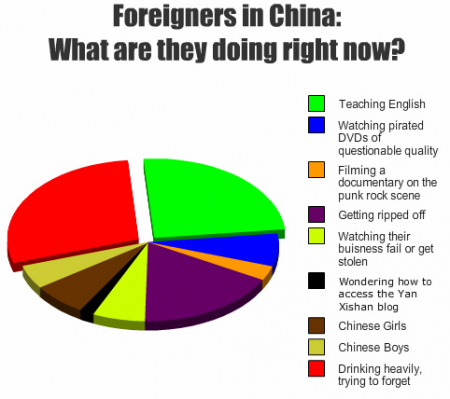
    What are foreigners doing in China?

    When I was in China, I was thinking what foreigners are up to in China. So, I search around and  found this survey from a Chinese blogger. Let’s check it out here:


    By the way, I wonder if I am considered myself as Foreigner in China. The reason is the Chinese usually calls “Foreigner” as “Laowai” which refers to white men or western guys. However, technically speaking I’m not really a “Laowai”. So, I’m not sure if this survey includes me.

    Now back to this survey, what do you think? Do you think that is the real survey or it is meant for joke or probably just a guess by the blogger’s owner?


    P/S: Happy Labour's Day! Enjoy your long weekend especially you're off on Monday too! :)